The Meermin was a hoeker class ship of 450 tons, built in 1759 at the Amsterdam Yard for the Amsterdam Chamber of the Dutch East India Company, and used by the Cape authorities as a slaver ship. In1766, a slave mutiny occurred on the Meermin, under the command of Captain Gerrit Christoffel Muller, en route between Madagascar and Cape Town. Over 140 Madagascan slaves revolted against the Dutch East India company (VOC) crew manning the vessel and assumed control of the ship.
On the return trip to the Cape, Muller, who had become ill, had the slaves, many of whom were also ill, released from their shackles. Discipline amongst the crew had broken down with many of them carrying on long drinking sessions. Muller also allowed the slaves on deck for chores and to entertain the Meermin’s celebrating crew. Vigilance was further relaxed when the ship neared the Cape. Foolishly, the First Mate in charge, Crause, even had the slaves clean a range of weapons including a collection of exotic Malagasy weapons.
The slaves seized upon the opportunity, killing many of the crew before most a number of the crew and Captain barricaded themselves below deck or fled into the rigging. Those who had sought refuge amid the sails eventually came down, but were tossed overboard and killed.
With the slaves in control of the deck and the remaining crew marooned below, the situation was a stalemate. The outnumbered crew was sidelined, while the slaves who controlled the deck could not steer the ship. The stalemate continued for two days. The crew tried a number of unsuccessful maneuvers to regain control but later turned to negotiations through one of the female slaves assisting the Second Mate. Negotiations and mutual threats resulted in a deal that the unharmed crew would sail the ship but return the slaves to Madagascar. Seemingly, the crew complied but instead sailed for the Cape. In an attempt to outfox the slaves, the crew sailed one way during the day and another, at a much faster speed, during the night. On the fourth day, the Meermin neared Cape Agulhas. The Second Mate and negotiator, Olaf Leij who had some mastery of Malagasy languages, convinced the slaves that the landmark was part of Madagascar, and anchor was dropped.
To make contact with people on land, some 60 slaves piled aboard two of the ship’s sloops. They would signal those remaining aboard that all was well ashore by lighting three fires. The arrival of the ship and the unusual activity had been seen by Cape farmers who set up an ambush when they realized the shore party was black. Fourteen slaves were killed and the rest captured.
The slaves aboard the Meermin anxiously were waiting for the signals from shore, as was the outnumbered crew. The sailors wrote a few terse messages to the Dutch ashore, put them in bottles in the hope the tide would carry the flasks to their intended location. The messages were found and brought to the local Landdrost, the area’s chief magistrate, who caught the meaning and complied to light the fires, further confusing the slaves on board.
Although the boats did not return to the ship, the slaves themselves agreed that all was well. They cut anchor and assumed that the Meermin could drift towards the shore of what they thought was Madagascar. An advance party was captured by the men of the Landdrost, but that was observed by those aboard. They turned on the remaining crew, which had dreaded this possible turn of events. Those on shore could not assist the Dutch sailors.
In the midst of the fighting, the Meermin ran aground on a sandbank. Olaf Leij was able to convince the slaves that further fighting was futile and promised them safety if they laid down their weapons. They agreed and soon were clamped into irons again. The crew again raised the Dutch flag, signaling an end to the uprising.
The ship was stuck in the sand however. Dispatch boats from the shore managed to rescue all aboard, but the Meermin was lost. For days, the crew and others were able to bring stuff ashore, but the ship was more and more engulfed in the sand and eventually was covered after it was battered by the waves and began to break up.
The 112 remaining slaves eventually were taken to Cape Town to be auctioned. Captain Muller was tried for culpable negligence, found guilty, striped of rank and pay, and discharged from the Company's service. The narrative of the Meermin has been documented several times, with varying degrees of accuracy and completeness. The ship has sometimes been confused with a later vessel, also named the Meermin, which was in operation during the 1780s. For reliable information on this story this BLOG directs anyone that is interested in learning more about the Meermin saga to the following Meermin website http://www.meermin.org
Monday, September 11, 2006


Sunday, September 10, 2006
Who were the Slave Traders serving the Cape?
Commander Jan van Riebeeck first Dutch East india Company (DEIC) governor at the Cape of Good Hope started the practice of slavery at the Cape. His own household included slaves from Angola, Guinea, Abyssinia, Batavia, Madagascar and Bengal. The DEIC had a dedicated Slave Lodge for up to 1000 company slaves, alongside the main vegatable plantation (next to the modern day Parliament buildings).
A number of slaver ships operated out of Cape Town to bring in new slaves regularly. The names of these were the Amersvoort, Leidsman, Voorhout, Eemlandt, Brak, Jambij and Meermin. In addition to these, slaver ships of many nationalities anchored in the Cape with 'cargoes' destined for Europe and the Americas. Some from amongst this 'cargo' were sold in the Cape. Those in the forefront of the slave trade included the Portuguese, Dutch, Danes, Swedes, French, Spanish, Arabs and coastal African collaborators. Until their about-turn the British were also in the forefront and they were joined by Americans, Russians and others. As time went on it became quite a free-for-all and included pirates too.
Many tragic sinkings of slaver ships occurred along our coast. In 1794 the slaver ship San Jose was wrecked between Camps Bay and Oudekraal and 250 slaves were drowned. In a case similar to the famous Amistad mutiny by slaves, the Meermin was wrecked on the South Coast near Arniston in 1766. I will leave this story for another posting in the future.
A number of slaver ships operated out of Cape Town to bring in new slaves regularly. The names of these were the Amersvoort, Leidsman, Voorhout, Eemlandt, Brak, Jambij and Meermin. In addition to these, slaver ships of many nationalities anchored in the Cape with 'cargoes' destined for Europe and the Americas. Some from amongst this 'cargo' were sold in the Cape. Those in the forefront of the slave trade included the Portuguese, Dutch, Danes, Swedes, French, Spanish, Arabs and coastal African collaborators. Until their about-turn the British were also in the forefront and they were joined by Americans, Russians and others. As time went on it became quite a free-for-all and included pirates too.
Many tragic sinkings of slaver ships occurred along our coast. In 1794 the slaver ship San Jose was wrecked between Camps Bay and Oudekraal and 250 slaves were drowned. In a case similar to the famous Amistad mutiny by slaves, the Meermin was wrecked on the South Coast near Arniston in 1766. I will leave this story for another posting in the future.
Emancipation
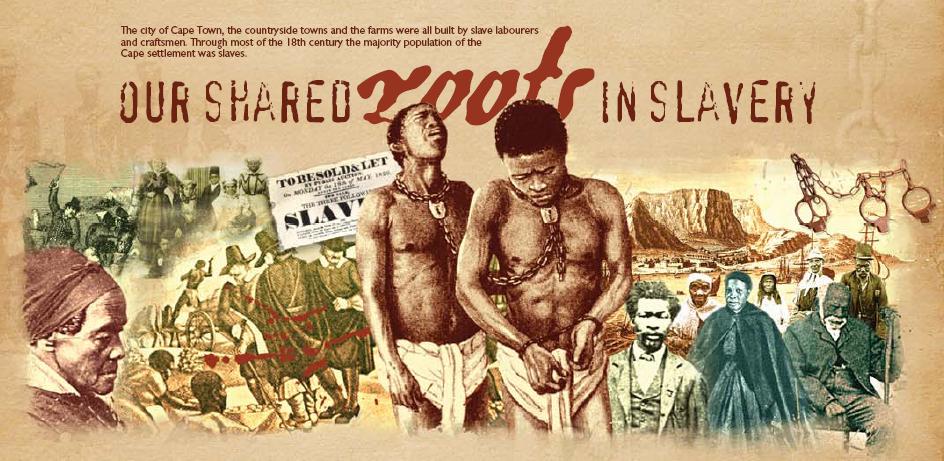
The photographs alongside the paintings and graphical images within this collage are all of people who were emancipated as slaves in 1834 in Cape Town. While emancipation occured on 1 December 1834, it only took effect from 1838 due to a legal clause bonding ex-slaves to 4 years of sevitude. Masters were also financially compensated while slaves were given no assistance to embrace their 'freedom'. By 1838 the last 38 427 slaves were freed. Since then descedants of slaves have celebrated 1 December as Emancipation Day.
Until that day, the only hope of freedom came from three practices - running away, revolt or manumission. Each is a story in itself and will be told in blogs. While 63 000 new slaves were brought to the Cape in small groups over a long period, it must be remembered that their many thousands of children, grand-children and great-grandchildren were all born into slavery and suffered the indignities of bondage, forced labour, punishment, and being bought and sold at the will of their masters.
Zanzibar Connection to the Cape

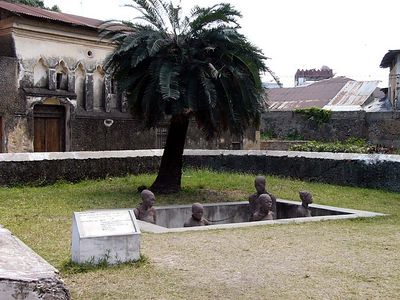 Memorial to slaves in Zanzibar. The memorial in Stone Town is a place of visitation for South Africans who wish to trace the steps of their ancestors. Many South African tourists visit Zanzibar without knowing this element of history that connects us. Cape Town is presently constructing a similar place of memorial to our slave forbears, on the corner of Buitengraght Street, bordered by Somerset Road and Waterkant Street (next to St Andrews Church).
Saturday, September 09, 2006
Where did the slaves come from and how many ?
During the entire period of slavery, from 1652 until 1834, around 63 000 new slaves were brought to the Cape. Of these 51,5% were from Africa and its islands of Zanzibar, Madagascar and the Mascarenes. A further 26% were from India-Bengal-Sri Lanka. Another 21% were from the islands of the Indonesian Archipelago. The rest were from an array of countries stretching from Persia to Thailand, Japan and China. While much of this slave trade was conducted in the Indian Ocean arena, in the early years the first slaves were taken in West Africa, mainly from Guinea and Angola. In the latter years of slavery other West Africans were so-called 'prize negroes' seized by the British from slavers on the high seas. The majority of African slaves were from Mozambique brought to the Cape in large numbers in the early 1700s, late 1700s and early 1800s. Other Africans were taken from the mainland first to Madagascar and then to the Cape. Others were from Mombassa. Indians were from Goa, down the Coast of Coromandel right through to the Bengal as well as from Sri Lanka. Those from the Archipelago came from Batavia, Java, Timor, Sumatra, Celebes, Malaccas, Bougies, Bouton, Ternate, Bali, Trankebar, Tidore, Ambonya. The language of the slave-ships was Portuguese-Malayu and from this derived the distorted term 'Cape-Malay' which often gave the impression that slaves were from Malaysia. Under the Apartheid system this term, popularised by the ideologue ID du Plessis, was formally adopted as an ethnic sub-category by the state, as a label for many 'Coloured' people holding the Muslim faith.
There is also another whole story (for another future blog) on indigenous South Africans being captured and used as slaves in South Africa and also in a few cases being sold through Mozambique and from the South African coast to slaver ships.
There is also another whole story (for another future blog) on indigenous South Africans being captured and used as slaves in South Africa and also in a few cases being sold through Mozambique and from the South African coast to slaver ships.
Slaves brought to South Africa?
To many abroad it seems somewhat peculiar when we talk of slaves being brought to South Africa. Many South Africans are also largely ignorant of this aspect of our history and heritage that dominated almost two centuries of colonial life. Those South Africans, even amongst some of the most learned, who do know something about slavery in the Cape have also often got caught up in a web of skewed information about this era due to ideological manipulation of history under the Apartheid system. Thus one will often find the word slaves prefixed as ‘Malay’ slaves even although there were hardly any slaves taken from what we today know as Malaysia and only just over 21% of all Cape slaves originated in the many islands and territories of the Indonesian Archipelago. There is much mythology to wade through in coming to a reasonably good understanding of slavery and Creolisation in Cape Town and South Africa. These pages are dedicated to telling this story so as to give a better understanding of the history and heritage of those who are called ‘Coloured’ today and to explore the hidden ties that bind so many across ethnic divisions in South Africa.
Subscribe to:
Posts (Atom)